

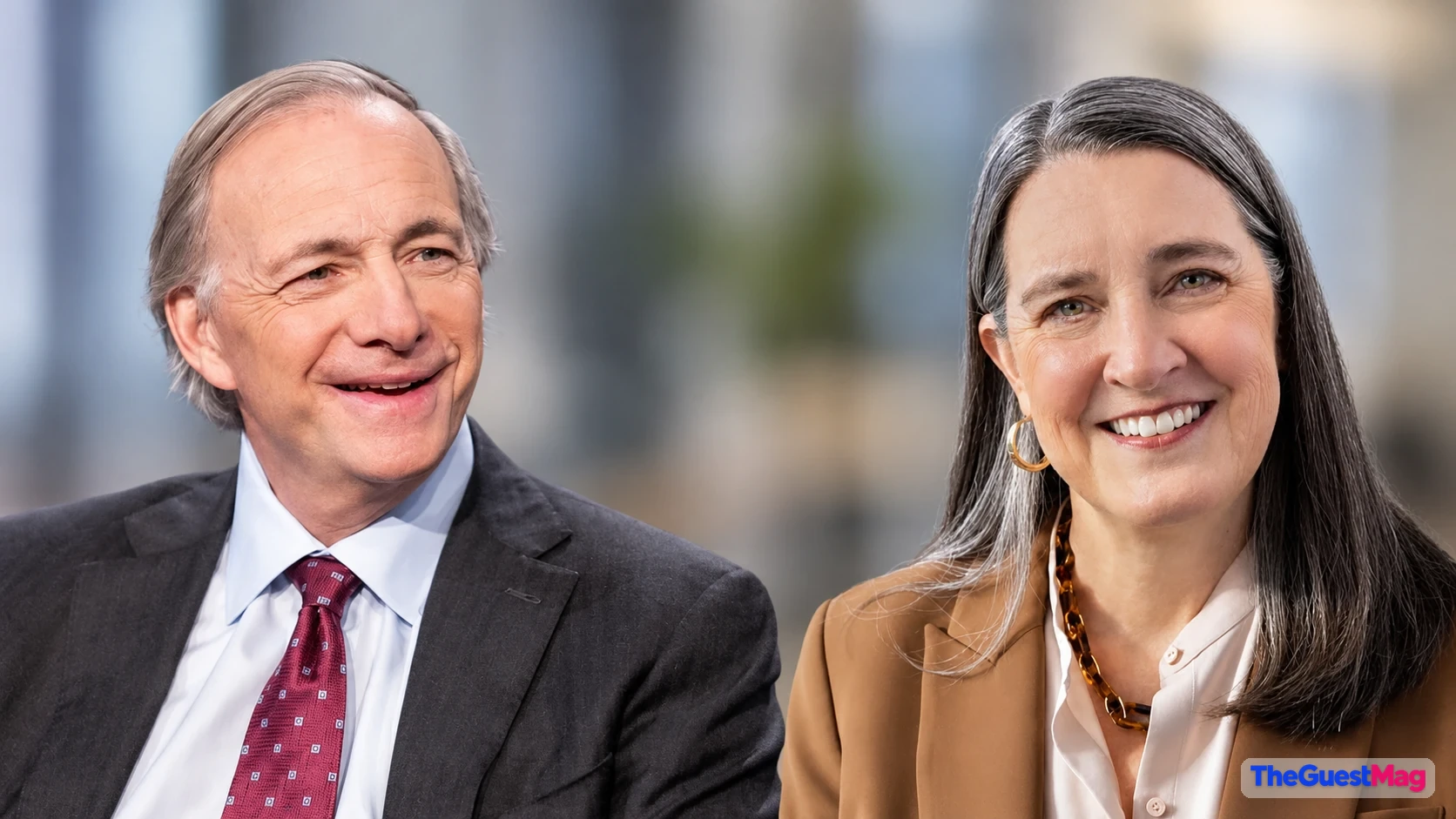
There is no publicly established personal or professional relationship between Ray Dalio and Patricia “Patti” Poppe. They are not known to be relatives, business partners or colleagues. The most concrete connection between their names is institutional: Bridgewater Associates, the investment firm Dalio founded but no longer runs, reported owning 5,931,314 shares of PG&E Corporation worth $99,764,701 at 30 June 2026. Poppe is PG&E Corporation’s chief executive.
That distinction matters. The regulatory filing belongs to Bridgewater Associates, not to Dalio personally, and it does not identify which individual at the firm selected PG&E. The reported $99.8 million figure is the position’s fair market value at the end of the quarter, not necessarily the amount Bridgewater paid for the shares.
The pairing is therefore best understood through two separate careers that happen to intersect indirectly through Bridgewater’s investment in the company Poppe leads.
The Bridgewater-PG&E connection
Bridgewater’s public filings show how sharply its disclosed PG&E position changed during 2026. At 31 March, the firm reported 24,531 PG&E shares valued at $431,010. By 30 June, the holding stood at 5,931,314 shares with a quarter-end value of $99,764,701.
Those filings establish a Bridgewater-PG&E investment connection, but they do not establish a Dalio-Poppe relationship. A Form 13F is an institutional investment-manager disclosure. It shows certain securities over which the manager exercises investment discretion; it does not function as a founder’s personal portfolio statement, nor does it normally identify the person inside a firm who made an individual stock decision.
That is especially important in Dalio’s case because his formal control of Bridgewater ended years before the PG&E position became substantial.
Ray Dalio: from founder to mentor
Raymond T. Dalio founded Bridgewater Associates in 1975, working initially from his two-bedroom apartment in New York City. Before that, he studied finance at C.W. Post College, graduating in 1971, and earned an MBA from Harvard Business School in 1973.
Bridgewater grew from a small advisory operation into a major investment-management firm associated with global macro investing: analysing broad forces such as inflation, growth, monetary policy and currencies rather than concentrating only on individual companies.
One of the firm’s best-known investment developments was All Weather, launched in 1996. Bridgewater’s own history describes the strategy as work involving Dalio and close colleagues rather than a single-person invention. Its purpose was to build a portfolio less dependent on any one economic environment by balancing exposure to different sources of risk.
Dalio also became known outside investment circles for his writing about decision-making and organisational culture. But his historical prominence at Bridgewater should not be confused with its present management.
He stepped down as chief executive in 2017, as chief investment officer in summer 2020, and as chairman at the end of 2021. Bridgewater says the transfer of control to its next generation of leadership was completed in 2022.
The separation continued. Reuters reported in July 2025, citing a Bridgewater client letter it had seen, that the firm had repurchased the final ownership shares held by Dalio-related entities. Bloomberg separately reported that Dalio had sold his remaining stake and left the board.
As of September 2026, Bridgewater still describes Dalio as its founder and as a mentor, but Nir Bar Dea is the firm’s CEO. Bridgewater also says its Investment Committee governs investment strategy and decisions.
That makes it inaccurate to describe the 2026 PG&E holding simply as “Ray Dalio’s investment”. Bridgewater is the investor named in the filing.
Patricia Poppe: an engineering and operations career
Patricia K. Poppe, widely known as Patti Poppe, reached the utility sector through a markedly different route.
She earned a bachelor’s degree in industrial engineering from Purdue University in 1989, followed by a master’s in the same subject in 1991. Purdue records also list a later master’s degree in management from Stanford Graduate School of Business. The university named her a Distinguished Engineering Alumna in 2017.
Her early career was rooted in manufacturing. Poppe spent about 15 years with General Motors before moving into the energy industry at DTE Energy, where her work included plant leadership. She later joined Consumers Energy and its parent, CMS Energy, eventually becoming president and chief executive of both companies.
In a 2024 discussion at UC Berkeley’s Haas School of Business, Poppe described how she had once set her sights on becoming a plant manager and deliberately took demanding frontline assignments to build operating experience. That account helps explain the progression of her career: from engineering and plant operations into responsibility for increasingly large energy systems.
Taking charge at PG&E after bankruptcy
Poppe became CEO of PG&E Corporation on 4 January 2021. Her arrival came roughly six months after PG&E emerged from Chapter 11 bankruptcy on 1 July 2020.
She entered a company facing intense scrutiny over safety, wildfire risk, infrastructure and regulation. In April 2021, the California Public Utilities Commission placed PG&E into the first step of an enhanced oversight process, citing shortcomings in how the utility had prioritised vegetation-management work near its highest-risk power lines during 2020.
That regulatory episode should be read with its later outcome. In December 2022, the CPUC determined that the required corrective actions had been completed and allowed PG&E to exit Step 1 of the process, although broader safety oversight continued.
Poppe’s role has therefore combined ordinary corporate leadership with the unusual demands of running a large regulated utility whose decisions affect safety, reliability, customer bills and major infrastructure investment.
Poppe’s exact role in 2026
A common point of confusion is the difference between PG&E Corporation and Pacific Gas and Electric Company.
Poppe remains CEO of PG&E Corporation, the parent holding company. She is also a director of both the corporation and its regulated utility subsidiary.
However, since 1 January 2026, Sumeet Singh has been CEO of Pacific Gas and Electric Company, the utility subsidiary. So describing Poppe simply as “CEO of Pacific Gas and Electric Company” is no longer precise.
The distinction matters because the two organisations have related but different governance roles within the PG&E structure.
PG&E’s current strategic review
Poppe’s current relevance extends beyond her title. On 2 September 2026, PG&E announced a strategic review of its business and financing structure aimed at addressing affordability and capital needs. The company said it expected to defer about $2 billion of work planned for 2027, while maintaining what it described as critical safety and compliance investment.
S&P Global separately reported that the process was expected to take roughly 12 to 18 months. No final restructuring outcome had been announced by the end of September 2026.
For Poppe, that review places questions of cost, investment and infrastructure firmly at the centre of her present role.
Why the Dalio connection should not be overstated
The temptation is to turn Bridgewater’s PG&E shareholding into a story about Dalio personally backing Poppe. The public record does not support that conclusion.
By the time Bridgewater reported its large PG&E position in the second quarter of 2026, Dalio had already stepped away from Bridgewater’s CEO, CIO and chairman roles, the firm had completed its transfer of control, and his remaining ownership interest had reportedly been bought out.
Nor does Bridgewater’s 13F state why the firm owned PG&E, who first proposed the investment, what its acquisition cost was, or whether Poppe’s management influenced the decision. The filing establishes the holding, not the investment thesis.
There is likewise no public confirmation that Dalio and Poppe are relatives, business partners or direct professional collaborators. That does not prove the two have never met or communicated; it simply means no such relationship is established in their documented public careers.
Two very different professional histories
Seen separately, the contrast between the two careers is straightforward.
Dalio built an investment institution around economic analysis, portfolio construction and market decision-making. His major professional work is tied to Bridgewater’s development, strategies such as All Weather, and the management principles he later published for a broader audience.
Poppe’s career developed through engineering, manufacturing, power generation and regulated utility management. Her responsibilities at PG&E concern physical infrastructure, safety, regulatory requirements, reliability, financing and the cost of serving millions of customers.
The similarity is therefore limited and general: both have spent their careers dealing with complex systems and consequential decisions. There is no need to invent a shared philosophy or partnership to make their individual records interesting.
Frequently asked questions
Are Ray Dalio and Patricia Poppe related?
There is no public confirmation that Ray Dalio and Patricia K. “Patti” Poppe are related.
Are Ray Dalio and Patti Poppe business partners?
No direct business partnership is publicly established. The strongest documented overlap is that Bridgewater Associates, the firm Dalio founded, held a substantial position in PG&E Corporation while Poppe served as its CEO.
Did Ray Dalio personally buy PG&E stock?
The available filing does not show that. Bridgewater Associates, LP is the institutional manager named on the Form 13F. It reported 5,931,314 PG&E shares worth $99,764,701 at 30 June 2026.
Does Ray Dalio still run Bridgewater?
No. He stepped down as CEO in 2017, CIO in 2020 and chairman at the end of 2021. Bridgewater completed the transfer of control in 2022, and Nir Bar Dea is now CEO.
Does Ray Dalio still own Bridgewater?
Reuters reported in July 2025 that Bridgewater had repurchased the final ownership shares held by Dalio-related entities. Bloomberg independently reported that he sold his remaining stake.
Is Patti Poppe still CEO of PG&E?
Yes, with an important qualification. As of 30 September 2026, Poppe is CEO of PG&E Corporation. Sumeet Singh is CEO of the subsidiary Pacific Gas and Electric Company.
Ray Dalio and Patricia Poppe are therefore best understood as two prominent business figures with separate careers and one identifiable institutional overlap. Bridgewater’s 2026 PG&E shareholding is real and substantial, but it belongs to Bridgewater’s disclosed portfolio, not to a documented personal partnership between its founder and PG&E Corporation’s chief executive.
